Best Gambling Books Every Bettor Should Read

💡 Key Takeaways
- Mathematical edge — not luck — is the foundation of every successful gambling operation, from card counting to sports betting markets.
- Bankroll management through the Kelly Criterion is more important than picking winners. Fortune's Formula and The Logic of Sports Betting are essential reading on this topic.
- Closing line value is the most reliable measure of long-term betting skill, more meaningful than short-term win/loss records.
- Cognitive biases — loss aversion, resulting, overconfidence — are the silent killers of betting bankrolls. Psychology books belong on every serious bettor's shelf.
- The goal is never to win every bet. It is to make consistently high-quality decisions over thousands of bets across months and years.
📑 Table of Contents
- Beat the Dealer — Edward O. Thorp
- Fortune's Formula — William Poundstone
- Sharp Sports Betting — Stanford Wong
- The Logic of Sports Betting — Ed Miller & Matthew Davidow
- Thinking in Bets — Annie Duke
- The Biggest Bluff — Maria Konnikova
- Trading Bases — Joe Peta
- Squares and Sharps, Suckers and Sharks — Joseph Buchdahl
- The Smart Money — Michael Konik
- A Man for All Markets — Edward O. Thorp
- Bringing Down the House — Ben Mezrich
- Moneyball — Michael Lewis
- The Signal and the Noise — Nate Silver
- Gambler — Billy Walters
- Thinking, Fast and Slow — Daniel Kahneman
Whether you're a recreational punter who throws a tenner on the weekend football or a data-obsessed sharp who lives and breathes expected value, the fastest way to level up your betting game has never been placing more bets — it has been picking up the right book.
The greatest gamblers in history didn't stumble into success. They studied it, modeled it, stress-tested it, and then refined it through thousands of hours of deliberate practice.
Beat the Dealer — Edward O. Thorp

Rank: 1 | Author: Edward O. Thorp | Published: 1962 (Revised 1966) | Category: Blackjack / Mathematics | Difficulty: Intermediate | Best For: Casino gamblers, blackjack players, mathematical thinkers
The first book to prove mathematically that blackjack could be beaten using card counting. Forced casinos to rewrite their rules and introduced the concept of dynamic house edge to mainstream gambling thought.
Key Takeaways: How to calculate deck composition advantage. Why the house edge is a dynamic rather than static number. How to apply mathematical edge-finding in real-time conditions.
Why Read It: Introduced expected value thinking to practical gambling and remains the foundational text for understanding mathematical edge in casino games.
Fortune's Formula — William Poundstone

Rank: 2 | Author: William Poundstone | Published: 2005 | Category: Bankroll Management / Mathematics | Difficulty: Beginner to Intermediate | Best For: Sports bettors, investors, anyone managing a bankroll over time
The most readable account of how the Kelly Criterion was discovered and applied across Las Vegas and Wall Street. Connects Claude Shannon, John Kelly, and Warren Buffett through a shared philosophy of optimal risk management.
Key Takeaways: The mathematics of optimal bet sizing. Why bankroll management is more important than picking winners. How professional investors and bettors share the same underlying risk philosophy.
Why Read It: Understanding the Kelly Criterion is non-negotiable for any serious bettor. This book makes it both understandable and compelling.
Sharp Sports Betting — Stanford Wong

Rank: 3 | Author: Stanford Wong | Published: 2001 | Category: Sports Betting Fundamentals | Difficulty: Beginner | Best For: Complete beginners to sports betting, NFL bettors
The gold standard primer for sports betting mechanics. Covers point spreads, money lines, totals, parlays, teasers, breakeven percentages, and line shopping with rare clarity and mathematical precision.
Key Takeaways: Fundamental sports betting concepts. Breakeven percentages at various juice levels. Line shopping strategy. The core mathematics of point spread wagering.
Why Read It: Every serious bettor needs to know that at -110 juice they must win 52.38% of bets to break even. This book teaches you that and everything else you need to know before placing serious money.
The Logic of Sports Betting — Ed Miller & Matthew Davidow

Rank: 4 | Author: Ed Miller & Matthew Davidow | Published: 2019 | Category: Sports Betting Strategy / Market Theory | Difficulty: Intermediate to Advanced | Best For: Intermediate and advanced bettors who want to understand markets
The most rigorous modern guide to how sports betting markets actually function. Explains closing line value, derivative market inefficiencies, live betting mechanics, and how to think like a professional market participant.
Key Takeaways: How sportsbook markets form and move. The concept of closing line value as the truest measure of betting skill. How to identify and exploit derivative market inefficiencies. Why beating the closing line matters more than short-term win rate.
Why Read It: Praised by a 30-year sportsbook manager as impossible to put down, this book upgrades your understanding of sports betting from tactical to structural.
Thinking in Bets — Annie Duke

Rank: 5 | Author: Annie Duke | Published: 2018 | Category: Psychology / Decision-Making | Difficulty: Beginner to Intermediate | Best For: Any bettor looking to improve decision quality and manage outcomes
Former WSOP champion and cognitive psychology PhD candidate Annie Duke explores why outcomes and decisions are not the same thing, and how to build the mental frameworks that lead to consistent long-term performance.
Key Takeaways: How to separate decision quality from outcome luck. The concept of resulting and why it distorts learning. How to think in probabilities rather than certainties. How to build mental frameworks that improve over time.
Why Read It: Described by the New York Times as a blueprint for modern investing, this is the most applicable psychology book in the gambling canon.
The Biggest Bluff — Maria Konnikova

Rank: 6 | Author: Maria Konnikova | Published: 2020 | Category: Poker / Psychology | Difficulty: Beginner | Best For: Poker players, behavioral psychology enthusiasts, beginners
Behavioral scientist Maria Konnikova learns poker under Hall of Famer Erik Seidel and wins a major tournament within a year, earning over $300,000 in live play while documenting the psychological science of decision-making under uncertainty.
Key Takeaways: The psychology of decision-making under uncertainty. How to pay genuine attention at the table and in life. The interplay between luck and skill. Why self-awareness is the most underrated gambling tool.
Why Read It: One of the most beautifully written gambling books ever produced, with deep psychological insight applicable far beyond poker.
Trading Bases — Joe Peta
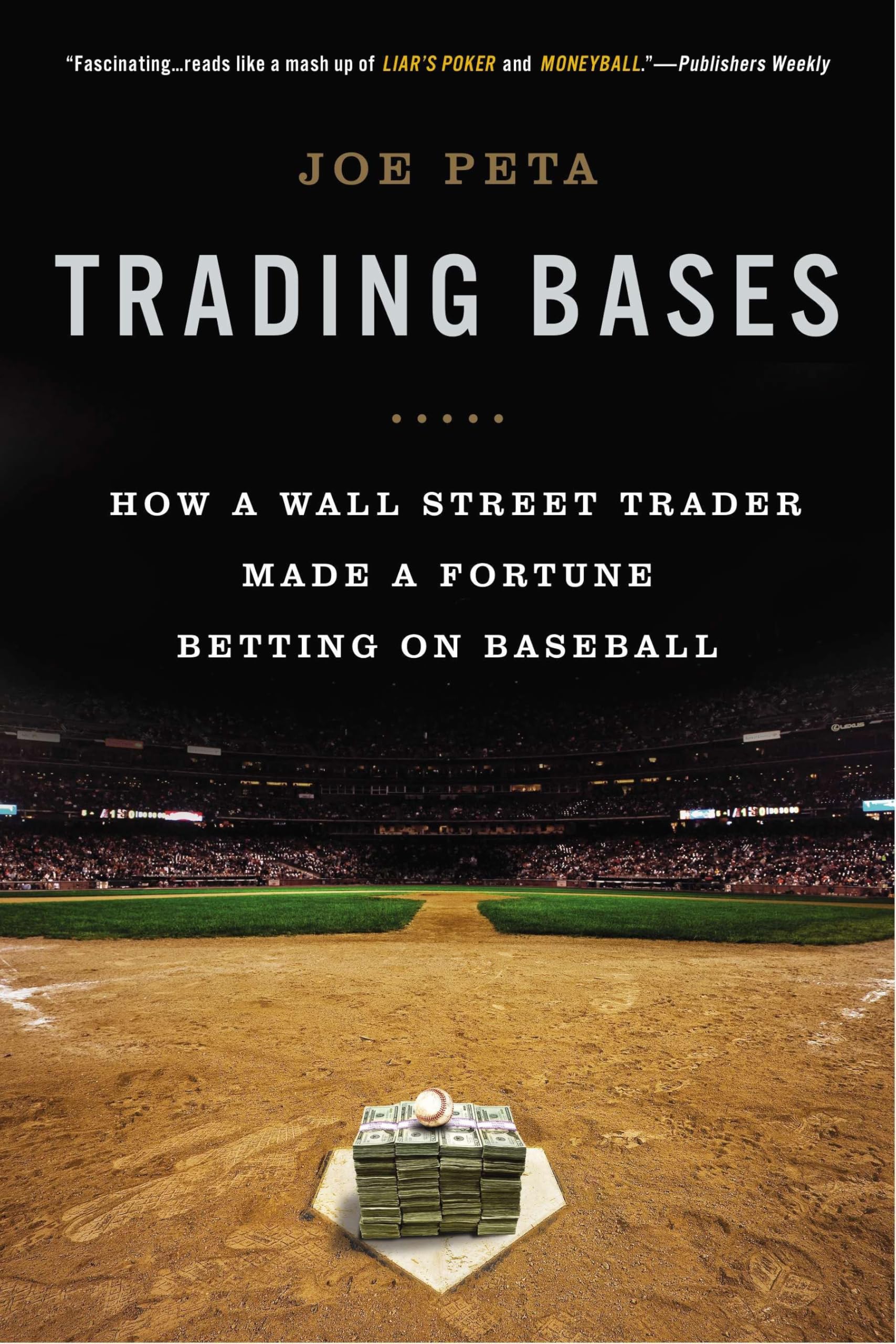
Rank: 7 | Author: Joe Peta | Published: 2013 | Category: Sports Betting / Quantitative Strategy | Difficulty: Intermediate | Best For: Data-driven bettors, baseball fans, quantitative thinkers
Ex-Wall Street trader Joe Peta applies financial market principles to betting on baseball, building a quantitative model that earned over $100,000 in a single season while documenting the emotional and strategic challenges of systematic betting.
Key Takeaways: How to apply financial market thinking to sports betting. Building a quantitative baseball betting model. The importance of ignoring recent performance noise. Systematic bankroll management through a full season.
Why Read It: The rare betting book that is both rigorous enough to teach you something real and well-written enough that you actually finish it.
Squares and Sharps, Suckers and Sharks — Joseph Buchdahl

Rank: 8 | Author: Joseph Buchdahl | Published: 2016 | Category: Betting Psychology / Statistical Analysis | Difficulty: Advanced | Best For: Analytically minded bettors who want to challenge their own assumptions
The most intellectually honest examination of sports betting markets ever written. Buchdahl systematically challenges the beliefs most bettors hold about their edge, using statistical evidence to demonstrate what it genuinely takes to beat the market.
Key Takeaways: The real statistical requirements for proving edge. Cognitive biases that damage betting performance. The efficiency of modern betting markets. How to think about your results with intellectual honesty.
Why Read It: Not a comfortable read, but one that will fundamentally improve your statistical self-awareness as a bettor.
The Smart Money — Michael Konik

Rank: 9 | Author: Michael Konik | Published: 2006 | Category: Narrative / Professional Betting | Difficulty: Beginner | Best For: Story-driven readers, anyone curious about professional sports betting culture
Gambling journalist Michael Konik embeds with a secretive team of professional sports bettors known as the Brain Trust, documenting how they operated, how they moved money, and how the adversarial dynamic with sportsbooks shaped every decision.
Key Takeaways: How professional sports betting operations actually function. The importance of bet placement timing and line shopping. The psychological demands of high-stakes betting. The adversarial dynamic between sharp bettors and sportsbooks.
Why Read It: Conveys what pure strategy texts cannot — the emotional reality of managing six-figure daily swings and the discipline required to treat them as statistical noise.
A Man for All Markets — Edward O. Thorp

Rank: 10 | Author: Edward O. Thorp | Published: 2017 | Category: Mathematical Biography / Investment | Difficulty: Intermediate | Best For: Advanced gamblers, investors, readers interested in mathematical biography
Edward Thorp's autobiography traces his arc from Beat the Dealer through the invention of the first wearable computer to founding some of Wall Street's most successful hedge funds, showing how a single analytical framework applied across all wagering environments.
Key Takeaways: The complete trajectory of applied probability thinking from casinos to financial markets. The unified framework Thorp applied across all wagering environments. The discipline required to apply mathematical edge over a lifetime.
Why Read It: Shows where mathematical edge-finding in gambling ultimately leads, and how consistent the underlying philosophy is across every domain.
Bringing Down the House — Ben Mezrich

Rank: 11 | Author: Ben Mezrich | Published: 2002 | Category: Blackjack / Narrative | Difficulty: Beginner | Best For: Casual readers, blackjack fans, narrative-driven learners
The story of the MIT blackjack team — six students who won millions across US and international casinos using card counting and team play — adapted into the film 21 but with significantly more detail and candor in the original book.
Key Takeaways: How team-based card counting actually worked in practice. The operational challenges of sustained professional gambling. How success itself eventually erodes a gambling edge.
Why Read It: Brings Thorp's mathematical principles to life through gripping narrative, while honestly documenting what eventually destroyed even a mathematically sound operation.
Moneyball — Michael Lewis

Rank: 12 | Author: Michael Lewis | Published: 2003 | Category: Sports Analytics / Market Inefficiency | Difficulty: Beginner | Best For: Sports bettors, data-driven thinkers, anyone interested in market inefficiency
The story of how Billy Beane's Oakland Athletics used statistical analysis to exploit systematic market inefficiencies in baseball talent valuation, a framework directly applicable to finding mispriced lines in sports betting.
Key Takeaways: How to identify market inefficiencies by questioning consensus metrics. The importance of finding undervalued signals before the market corrects them. Why observable, emotionally compelling data is often the least predictive.
Why Read It: The definitive case study in identifying and exploiting market inefficiencies — the exact skill set that separates profitable sports bettors from recreational ones.
The Signal and the Noise — Nate Silver

Rank: 13 | Author: Nate Silver | Published: 2012 | Category: Forecasting / Statistical Thinking | Difficulty: Intermediate | Best For: Bettors interested in forecasting, statistics, and prediction methodology
Nate Silver examines why most predictions fail while some succeed, using evidence from sports, politics, meteorology, and economics to build a comprehensive framework for thinking about uncertainty and avoiding the trap of mistaking noise for signal.
Key Takeaways: How to distinguish genuine predictive signal from statistical noise. The foundations of Bayesian probabilistic reasoning. Why over-fitting models to historical data is one of the most dangerous habits in analytical betting. How elite forecasters think about uncertainty.
Why Read It: Provides the statistical and philosophical foundations for building models that predict reliably rather than simply fitting past data.
Gambler — Billy Walters

Rank: 14 | Author: Billy Walters | Published: 2023 | Category: Autobiography / Sports Betting | Difficulty: Beginner | Best For: Sports bettors of all levels, anyone fascinated by professional gambling biography
The autobiography of arguably the most successful sports bettor in US history, who claims 36 consecutive profitable years. Candid about strategy, legal troubles, the Phil Mickelson relationship, and the extraordinary discipline required to sustain professional betting across decades.
Key Takeaways: How one of history's greatest sports bettors actually operated. The discipline required to maintain long-term profitability. The variables Walters identified as systematically underpriced by the market. An unflinching look at the personal costs of professional gambling.
Why Read It: The most recent and most specific first-person account of professional sports betting at the absolute highest level.
Thinking, Fast and Slow — Daniel Kahneman

Rank: 15 | Author: Daniel Kahneman | Published: 2011 | Category: Psychology / Behavioral Economics | Difficulty: Intermediate | Best For: All bettors, especially those who trade on intuition or struggle with discipline
Nobel Prize-winning psychologist Daniel Kahneman's definitive work on the two systems of human thought and how their interaction produces systematic cognitive biases — all of which have direct, costly applications in gambling behavior.
Key Takeaways: The cognitive architecture of human decision-making and where it fails. Why loss aversion is the most dangerous force in a bettor's psychology. How to recognize System 1 errors before they cost you money. Why overconfidence is the single most common predictor of long-term betting failure.
Why Read It: Understanding why you make irrational decisions is the prerequisite for stopping making them. This is the most rigorous and comprehensive guide to that understanding ever written.
Conclusion
The books on this list represent something genuinely rare in a world full of systems vendors, tout services, and subscription-based tipping platforms making impossible promises: honest, rigorous, tested knowledge about how gambling actually works.
The most important idea threading through all fifteen of these titles is that the goal is not to win every bet — it is to make decisions of consistently high quality. The house has spent decades perfecting its edge. The sharpest bettors spend a lifetime perfecting theirs. These books are the best starting point available.
Disclaimer: This article is intended for educational and informational purposes. Gambling involves risk, and past performance is not a guarantee of future results. Always gamble responsibly and within your means.
❓ Frequently Asked Questions
Do I need to be a professional gambler to benefit from these books?
Not at all. The majority of these books are written accessibly enough for recreational bettors, and several — particularly Thinking in Bets, Moneyball, and The Biggest Bluff — are genuinely valuable for anyone who makes decisions under uncertainty. Even if you bet $20 a week on football, understanding the mathematical and psychological concepts in these books will improve your results and your enjoyment of the process.
Which book is best for understanding bankroll management specifically?
Fortune's Formula by William Poundstone is the gold standard for understanding the Kelly Criterion and the mathematics of optimal bet sizing. Paired with the relevant sections of The Logic of Sports Betting, these two books give you everything you need to never again blow a bankroll through overbetting a perceived edge.
Are any of these books focused on casino games rather than sports betting?
Yes. Beat the Dealer and Bringing Down the House are primarily about blackjack, while Fortune's Formula spans both casino and financial markets. A Man for All Markets covers roulette, blackjack, and financial trading. The psychology books — Thinking in Bets, Thinking Fast and Slow, and The Biggest Bluff — apply universally across all forms of gambling and beyond.
Is card counting still a viable strategy worth learning in 2026?
The short answer is that it is far more difficult than it was when Thorp published Beat the Dealer in 1962. Modern casinos use 6- and 8-deck shoes, continuous shuffle machines, and highly trained surveillance staff. That said, the mathematical principles remain valid and inform broader thinking about edge-finding in any gambling context.
How long does it typically take to see improvement in betting results after reading these books?
Improving your betting is a long-term project measured in thousands of bets over months and years. Psychology books like Thinking in Bets and Thinking, Fast and Slow will create observable changes in your decision quality fairly quickly. More technical books on market theory and bankroll management compound their value over much longer periods.
Do any of these books cover modern sports betting concepts like same-game parlays or live betting?
The Logic of Sports Betting is the most current text on this list and covers live betting with particular depth, including the specific challenges of streaming delays and in-play market efficiency. Same-game parlays are not covered in depth by any book here — partly because most analytical bettors treat them skeptically as a higher-hold product.
Are these books suitable for someone who is new to gambling entirely?
Several of them are ideal entry points for a complete beginner. Start with Thinking in Bets to build the right mental framework, then move to Sharp Sports Betting for the mechanics, and then Fortune's Formula for bankroll discipline. This three-book sequence gives any newcomer a more solid foundation than 99% of recreational bettors ever develop.
Conclusion
The books on this list represent something genuinely rare in a world full of systems vendors, tout services, and subscription-based tipping platforms making impossible promises: honest, rigorous, tested knowledge about how gambling actually works.
The most important idea threading through all fifteen of these titles is that the goal is not to win every bet — it is to make decisions of consistently high quality. The house has spent decades perfecting its edge. The sharpest bettors spend a lifetime perfecting theirs. These books are the best starting point available.
Disclaimer: This article is intended for educational and informational purposes. Gambling involves risk, and past performance is not a guarantee of future results. Always gamble responsibly and within your means.
FREE STATS & STAKING TRACKER
Log your bets, track CLV, and manage your bankroll like a pro with our institutional-grade tracking tool.
OPEN FREE TRACKER