The Best Gambling Movies of All Time, Ranked

💡 Key Takeaways
- Casino (1995) remains the undisputed king of gambling cinema — a three-hour epic of power, paranoia, and the slow destruction of the American dream.
- Rounders (1998) is widely credited with igniting the global poker boom of the early 2000s and remains required viewing for any serious poker player.
- Uncut Gems (2019) is arguably the most viscerally stressful gambling film ever made, showcasing Adam Sandler in his career-best dramatic performance.
- The best gambling movies use the bet as a metaphor — for self-worth, addiction, control, and the human need to believe in a favorable outcome against the odds.
- From 1965's The Cincinnati Kid to 2019's Uncut Gems, these films span over five decades and consistently rank among the most critically acclaimed pictures of their respective eras.
📑 Table of Contents
- What Makes a Great Gambling Movie?
- #1 — Casino (1995)
- #2 — Rounders (1998)
- #3 — The Sting (1973)
- #4 — Uncut Gems (2019)
- #5 — California Split (1974)
- #6 — The Cincinnati Kid (1965)
- #7 — Molly's Game (2017)
- #8 — Rain Man (1988)
- #9 — The Color of Money (1986)
- #10 — Hard Eight (1996)
- #11 — Owning Mahowny (2003)
- #12 — Croupier (1998)
- #13 — 21 (2008)
- #14 — Mississippi Grind (2015)
- #15 — Maverick (1994)
- #16 — The Gambler (1974)
- #17 — Lock, Stock and Two Smoking Barrels (1998)
- Honorable Mentions
- The Psychology Behind Gambling Cinema
There is no genre in cinema that captures the raw, primal thrill of human risk-taking quite like the gambling movie. From the sweat-soaked felt of a back-room poker table to the dazzling neon labyrinth of the Las Vegas Strip, these films hold up a mirror to our deepest desires — for fortune, for control, and for the intoxicating rush of having everything on the line.
The greatest gambling films are not really about cards, dice, or chips. They are character studies, crime dramas, and psychological deep-dives into what compels a person to keep betting when logic screams to walk away. They are about obsession, identity, masculinity, class, greed, and the beautiful lie that the next hand will be the one that changes everything.
We have ranked the 17 greatest gambling movies ever committed to film — judged by critical reception, cultural impact, authenticity, and their ability to make you feel the electricity of the bet in your own chest. Whether you are a seasoned sharp or a casual viewer, this is your definitive guide to the genre at its absolute best.
What Makes a Great Gambling Movie?
Before diving into the rankings, it is worth examining what separates a great gambling movie from a forgettable one. The worst examples in the genre lean on surface-level excitement — spinning roulette wheels, dramatic river cards, villain antagonists with no moral complexity. The best, however, use gambling as a lens through which to examine the human condition itself.
The finest gambling films share several core qualities. First, they make the stakes feel personal. We must care about the character before we care about their hand. Second, they are technically authentic — real players and professionals can watch without wincing at glaring inaccuracies. Third, and most importantly, they understand that gambling is fundamentally about psychology. The tension is not in the cards; it is in the minds of the players across the table.
The genre has produced some of cinema's most iconic performances, from Paul Newman's pool-shark swagger to Adam Sandler's career-defining unraveling in Uncut Gems. It has also given us two of the most endlessly quotable lines in movie history — 'Is this a poker game or a knitting circle?' from The Cincinnati Kid and 'We're not playing together, we're not splitting pots, and we're definitely not going to be friends' from Rounders.
With those criteria firmly in mind, here is the definitive ranking of the greatest gambling movies ever made.
#1 — Casino (1995)

Director: Martin Scorsese | Stars: Robert De Niro, Sharon Stone, Joe Pesci | IMDb: 8.2/10 | Rotten Tomatoes: 79% | Box Office: $116 million worldwide
No gambling film has ever been made with the scope, ambition, or sheer operatic grandeur of Martin Scorsese's Casino. Running nearly three hours, it chronicles the rise and catastrophic fall of Sam 'Ace' Rothstein (Robert De Niro), a handicapper turned casino boss who comes to oversee the Tangiers Casino in Las Vegas on behalf of the Kansas City mob. It is a film about the corruption of paradise — the systematic dismantling of a world built on controlled greed by the uncontrolled variety.
What sets Casino apart from every other gambling film ever made is its total commitment to authenticity. Scorsese and co-writer Nicholas Pileggi (who wrote the source book) spent years researching the mob-controlled Las Vegas of the 1970s and 1980s. Every detail — the skimming operations, the counting room procedures, the relationship between casino management and organized crime — was meticulously verified. The film feels less like a dramatization and more like a documentary that happens to have the most electrifying performances of the decade.
Sharon Stone's portrayal of Ginger McKenna earned her an Academy Award nomination and remains one of the most searing, complex depictions of a woman destroyed by a world she cannot escape. Joe Pesci reprises his terrifying energy as Nicky Santoro, a figure based on real-life enforcer Anthony Spilotro. But it is the film's central tragedy — the slow, inevitable unraveling of a man who believed that intelligence and discipline could tame the chaos of Vegas — that gives Casino its lasting power.
Scorsese uses voiceover narration from multiple characters simultaneously, a technique that mirrors the sensory overload of the casino floor itself. The opening sequence, set to 'Love Is Strange' by Mickey & Sylvia, is one of the most technically accomplished in American cinema. Casino is not just the greatest gambling movie ever made — it is one of the greatest American films of the 20th century, period.
#2 — Rounders (1998)

Director: John Dahl | Stars: Matt Damon, Edward Norton, John Malkovich | IMDb: 7.3/10 | Rotten Tomatoes: 64% | Box Office: $22.9 million worldwide
If Casino is the king of gambling cinema as spectacle, Rounders is the king of gambling cinema as culture. No film has had a more direct and measurable impact on the gambling world itself. Released in 1998 to modest box office returns, Rounders spent years circulating on cable television and home video — and in doing so, it quietly ignited the global poker boom of the early 2000s. Countless professional players have cited it as the film that made them pick up a deck of cards.
Matt Damon plays Mike McDermott, a reformed poker prodigy who has given up the game to pursue a law degree. When his childhood friend Lester 'Worm' Murphy (Edward Norton, at his most magnetic and self-destructive) is released from prison and immediately falls into ruinous debt, Mike is dragged back to the underground poker rooms of New York City. The film culminates in a heads-up confrontation with the legendary KGB (John Malkovich, doing the single greatest acting job in gambling cinema history — an outrageous Russian accent that somehow becomes terrifying).
What makes Rounders work as both cinema and as a poker education is its commitment to the intellectual dimensions of the game. The film understands that poker is a game of incomplete information, psychological inference, and long-term expected value. 'You can't lose what you don't put in the middle,' Mike tells us early on. 'But you can't win much either.' It is the film's thesis statement and one of the most elegant summations of risk philosophy ever put into a screenplay.
The line 'He's about to go home and rethink his life' — delivered by Damon after reading KGB's tell — has been quoted at poker tables worldwide for nearly three decades. Rounders is the reason the World Series of Poker became a television event. Its legacy in the gambling world is simply unparalleled.
#3 — The Sting (1973)

Director: George Roy Hill | Stars: Paul Newman, Robert Redford, Robert Shaw | IMDb: 8.3/10 | Rotten Tomatoes: 82% | Box Office: $156 million | Academy Awards: 7, including Best Picture
The Sting is the most purely pleasurable gambling movie ever made. Set in Depression-era Chicago, it follows two small-time grifters — Henry Gondorff (Paul Newman) and Johnny Hooker (Robert Redford) — as they construct an elaborate long con against a ruthless crime boss (Robert Shaw) to avenge the murder of a mutual friend. The film won seven Academy Awards, including Best Picture, and remains one of the highest-grossing films of its era when adjusted for inflation.
The centrepiece of The Sting is a poker game aboard a train — one of the most perfectly constructed sequences in Hollywood history. Newman, playing a supposedly drunk cardsharp, runs a crooked game of cards with such casual, devastating elegance that it functions as pure cinema. The scene has been studied in film schools for fifty years, not because of its technical virtuosity (though it has that in abundance) but because of the way it uses the poker table as a stage for a performance-within-a-performance.
What elevates The Sting above the ordinary con-artist picture is the screenplay by David S. Ward, which constructs a series of elaborate misdirections for the audience as well as the mark. The film takes genuine pleasure in the intelligence of its characters and in the audience's own desire to be fooled. It is a movie about gambling that is itself a gamble — betting that viewers will enjoy being deceived if the deception is elegant enough.
Scott Joplin's ragtime score — arranged by Marvin Hamlisch — became one of the most recognizable in cinema history, reaching number one on the pop charts with 'The Entertainer' nearly forty years after Joplin's death. The Sting is a film of almost perfect construction, a clockwork mechanism that runs with the precision of a professional cheat's hand.
#4 — Uncut Gems (2019)

Directors: Josh and Benny Safdie | Stars: Adam Sandler, Julia Fox, Kevin Garnett | IMDb: 7.4/10 | Rotten Tomatoes: 91% | Box Office: $50.1 million worldwide
Uncut Gems is the most stressful film on this list and, by several critical measures, the most artistically accomplished gambling film made in the 21st century. The Safdie Brothers' 2019 thriller drops the viewer into the chaos of Howard Ratner (Adam Sandler), a New York City jeweller and compulsive gambler who spends the entire film pirouetting between catastrophic debt and euphoric near-escape. The movie does not give you a single moment to breathe. It is designed to induce the same cortisol-soaked panic that compulsive gambling itself produces.
Sandler's performance is nothing short of extraordinary. Playing a man who is simultaneously brilliant and catastrophically self-destructive, who genuinely cannot distinguish between a winning system and an addiction, Sandler delivers the best work of his career — and one of the great performances of the decade. The Academy's failure to nominate him remains one of the most contentious snubs in Oscar history.
The film's central MacGuffin — a black opal from an Ethiopian mine that Howard believes will fund the bet that finally breaks him even — is a genius piece of screenwriting. It represents the gambler's eternal belief in the talismanic object, the lucky charm, the system. Howard is not an idiot; he is a man who understands probability and believes, with an almost religious certainty, that the universe owes him a win.
Uncut Gems is also a brilliant study of the modern sports-betting ecosystem. Kevin Garnett, playing himself, becomes caught up in Howard's delusional orbit in a way that blurs the line between celebrity culture, sports betting, and the seductive mythology of luck. The film's final fifteen minutes are as tightly wound and brilliantly executed as anything in modern American cinema. It is an experience more than a movie — a simulation of the compulsive gambler's existence that is almost unbearable to witness and completely impossible to stop watching.
#5 — California Split (1974)

Director: Robert Altman | Stars: Elliott Gould, George Segal | IMDb: 7.2/10 | Rotten Tomatoes: 91% | Box Office: $6.6 million
Robert Altman's California Split is the most honest gambling movie ever made. While other films in the genre romance the bet, California Split looks at gambling with the clear-eyed, unromantic gaze of a man who knows exactly what he is describing. Two strangers — Bill Denny (George Segal) and Charlie Waters (Elliott Gould) — meet at a poker club in Los Angeles and form the loose, ambling friendship of two men who have nothing better to do than keep playing.
The film refuses the genre's usual dramatic architecture. There is no climactic tournament, no arch villain, no redemptive arc. Instead, Altman and screenwriter Joseph Walsh (who drew on his own gambling experiences) present gambling as a lifestyle — drab, repetitive, occasionally thrilling, and ultimately empty. The movie follows its characters through poker rooms, racetracks, and casino floors with the same observational detachment Altman would bring to MASH and Nashville. It is a film about the texture of a certain kind of life, not the drama of a single bet.
California Split was technically groundbreaking — it was one of the first films to use a sophisticated multi-track sound design, with overlapping dialogue that mimics the ambient noise of a real casino. This technique placed the audience inside the environment rather than observing it from a safe, cinematic distance. The film's ending, in which Bill wins a massive poker pot in Reno and feels absolutely nothing, remains the most devastating and truthful conclusion in gambling cinema. You can win and still lose everything.
#6 — The Cincinnati Kid (1965)

Director: Norman Jewison | Stars: Steve McQueen, Edward G. Robinson, Ann-Margret | IMDb: 7.2/10 | Rotten Tomatoes: 82%
The Cincinnati Kid is the founding text of the poker movie. Set in Depression-era New Orleans, it pits 'The Kid' (Steve McQueen), a young poker hotshot hungry to establish himself as the best, against 'The Man' — Lancey Howard (Edward G. Robinson), the unflappable veteran champion of five-card stud. Everything about the film — the mythology of the mentor-vs-protégé confrontation, the romantic subplot, the corrupt game organizer — has been recycled by the genre ever since.
Steve McQueen's performance as The Kid is a study in barely contained ambition and carefully performed cool. He is a man who believes that talent and nerve are enough to beat the world, and the film's great subject is whether that belief is justified. Edward G. Robinson, in one of the final great roles of his career, brings a stillness and authority to Lancey that makes every scene between them feel like a genuine clash of eras and philosophies.
The climactic stud poker duel between McQueen and Robinson remains the most celebrated heads-up hand in movie history. The final deal — in which The Kid holds a full house, aces over tens, and still loses to The Man's straight flush — is simultaneously statistically outrageous and thematically perfect. It says everything the film wants to say about the relationship between talent, luck, and the cruelty of the game. 'Gets down to what it's all about, doesn't it?' Robinson says at the end, with a smile that contains lifetimes. 'Making the wrong move at the right time.'
#7 — Molly's Game (2017)

Director: Aaron Sorkin | Stars: Jessica Chastain, Idris Elba, Kevin Costner | IMDb: 7.4/10 | Rotten Tomatoes: 82% | Box Office: $59.3 million worldwide
Aaron Sorkin's directorial debut is the most underrated gambling film of the modern era. Based on the true story of Molly Bloom — Olympic-level skier turned organizer of the world's most exclusive underground poker games — it is a film about intelligence, ambition, and the price of operating in a world designed to exclude you. Molly's games attracted billionaires, celebrities, athletes, and eventually the Russian mob. The film explores how she built this empire and what it cost her.
Jessica Chastain's performance is among the finest in the gambling genre — a portrayal of a woman who is demonstrably smarter than almost everyone in every room she enters, using the poker game as a vehicle for a kind of authority that the legitimate world would never have offered her. The film is also a masterclass in how to explain complex card play to non-poker audiences without losing dramatic momentum.
What makes Molly's Game particularly compelling from a betting perspective is its understanding of the psychology of high-stakes players. Sorkin's script dissects the motivations of the ultra-wealthy men who populated Bloom's games — the thrill of competition stripped of financial consequence, the ego gratification of the bluff, the bizarre intimacy of the poker table. The scene in which Molly explains why she began keeping tips (and eventually rake) is one of the finest pieces of gambling ethics in any film. Molly's Game is a thriller, a character study, and a business case study rolled into one of the most rewatchable films of the 2010s.
#8 — Rain Man (1988)

Director: Barry Levinson | Stars: Dustin Hoffman, Tom Cruise | IMDb: 8.0/10 | Rotten Tomatoes: 89% | Box Office: $354 million worldwide | Academy Awards: 4, including Best Picture
Rain Man is not a gambling movie in the strict sense — it is a road movie and a study of an unlikely brotherly bond. But it contains the most culturally consequential casino sequence ever filmed. The Las Vegas blackjack scene, in which Raymond Babbitt (Dustin Hoffman) deploys his extraordinary mathematical abilities to systematically beat the house, introduced the concept of card counting to a global mainstream audience and permanently altered the way casinos approached basic strategy players.
Hoffman's portrayal of Raymond, an autistic savant, won him the Academy Award for Best Actor and remains one of the most carefully researched performances in Hollywood history. His card-counting methodology — while dramatized for cinematic effect — is grounded in genuine blackjack mathematics. The film's portrayal of the casino's reaction (suspicion, back-rooming, eventual barring) also accurately reflects real counter-countermeasures that casinos employ to this day.
What makes the gambling sequence in Rain Man so powerful is that it functions as the emotional resolution of the brothers' relationship. Charlie (Tom Cruise) begins the film seeing Raymond purely as a windfall asset; the Las Vegas section represents the moment that calculation shifts into genuine affection. The bet becomes the mechanism through which a selfish man discovers something worth more than money. Rain Man used the casino floor more thoughtfully than almost any other film on this list.
#9 — The Color of Money (1986)

Director: Martin Scorsese | Stars: Paul Newman, Tom Cruise, Mary Elizabeth Mastrantonio | IMDb: 7.0/10 | Rotten Tomatoes: 68% | Box Office: $52.3 million | Academy Awards: Paul Newman, Best Actor
Martin Scorsese's sequel to The Hustler (1961) is the film that finally won Paul Newman his Oscar — a long-overdue recognition of one of Hollywood's most consistently brilliant careers. Newman reprises his role as Fast Eddie Felson, now a liquor distributor who rediscovers his competitive fire when he spots the raw talent of Vincent Lauria (Tom Cruise), a pool prodigy he takes on as a protégé.
The Color of Money is the best film ever made about the relationship between natural ability and developed craft — about what it means to be not just talented but professional. The film's understanding of hustling (the deliberate sandbagging of one's abilities to manipulate opponents and odds) is nuanced and authentic. Scorsese treats pool with the same reverence he would later bring to boxing in Raging Bull and music in The Last Waltz — as a discipline that demands total commitment and rewards only those willing to pay its full price.
Tom Cruise's energetic, slightly irritating performance as the showy, undisciplined Vincent is the perfect foil for Newman's weathered wisdom. The film builds to a climactic Atlantic City tournament confrontation that Scorsese deliberately refuses to resolve in conventional terms — a bold choice that prioritizes character truth over genre satisfaction. Warren Zevon's iconic 'Werewolves of London' opening sequence remains one of the great cinematic entrances of the decade.
#10 — Hard Eight (1996)

Director: Paul Thomas Anderson | Stars: Philip Baker Hall, John C. Reilly, Gwyneth Paltrow, Samuel L. Jackson | IMDb: 7.0/10 | Rotten Tomatoes: 79%
Paul Thomas Anderson's debut feature is the most criminally underseen film on this list. Originally titled Sydney, Hard Eight is a quiet, devastating study of a mysterious high-roller named Sydney (Philip Baker Hall) who takes a young, broke drifter named John (John C. Reilly) under his wing and teaches him the protocols of professional casino play — craps systems, casino comps, the language of the grind.
What makes Hard Eight extraordinary is what it does not say. Sydney's motivation for helping John is deliberately obscured for most of the film's running time, and when the explanation finally arrives, it recontextualizes everything that came before with a terrible, melancholic weight. Philip Baker Hall's performance — a masterwork of understated gravitas — is one of the finest in American independent cinema of the 1990s.
Anderson uses the casino environment not as spectacle but as moral landscape — a world of provisional rules and surface hospitality that conceals genuine menace. Samuel L. Jackson's brief appearance as a dangerous small-time crook who threatens John's safety generates more tension in fifteen minutes than most gambling films sustain over two hours. Hard Eight is the film that announced Paul Thomas Anderson as a major directorial talent and remains essential viewing for anyone serious about the gambling genre.
#11 — Owning Mahowny (2003)

Director: Richard Kwietniowski | Stars: Philip Seymour Hoffman, Minnie Driver, John Hurt | IMDb: 7.0/10 | Rotten Tomatoes: 79% | BAFTA: Philip Seymour Hoffman, Best Actor
Owning Mahowny is the most clinically accurate portrayal of gambling addiction ever committed to film — and one of the most quietly devastating. Based on the true story of Brian Mahowny, a Canadian bank manager who embezzled $10.2 million (Canadian) to fuel a casino gambling habit in the early 1980s, the film refuses to glamorize its subject even for a moment.
Philip Seymour Hoffman's Mahowny is not romantic, charismatic, or particularly tortured in the conventional movie sense. He is methodical, soft-spoken, and totally consumed. When asked by a psychologist to rate his happiness on a scale of one to ten during a gambling high, he says without hesitation: 'Twenty.' The film understands — and conveys with devastating clarity — that for a compulsive gambler, the bet is not about winning. It is about the state of arousal produced by the act of wagering itself.
John Hurt is superb as the casino manager who recognizes Mahowny as the most reliable source of income he has ever encountered and systematically enables his destruction. The film's portrayal of the casino's relationship with the problem gambler — simultaneously exploitative and paternalistic — is the most honest in the genre. Owning Mahowny won Hoffman a BAFTA and deserved far wider recognition than it received.
#12 — Croupier (1998)
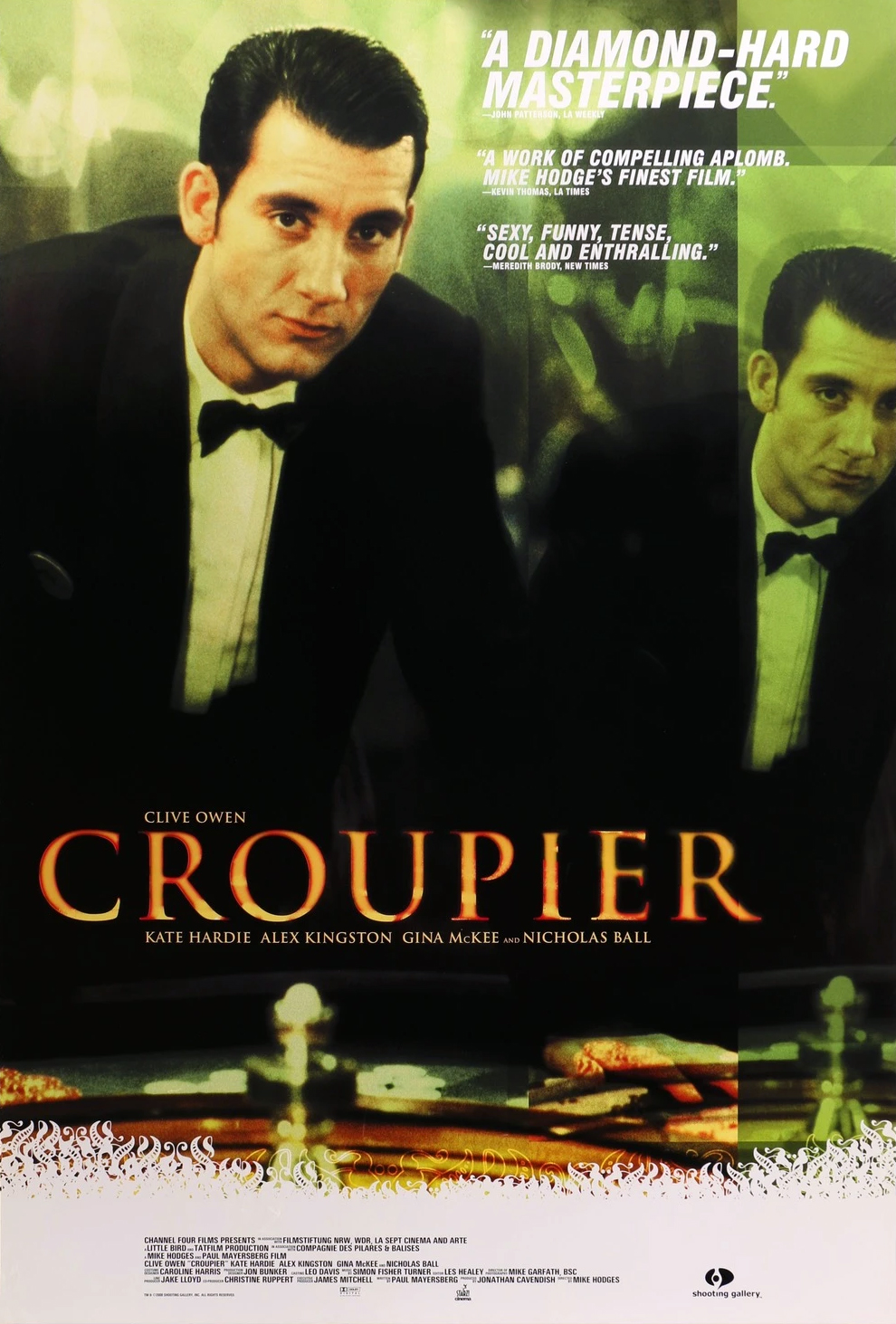
Director: Mike Hodges | Stars: Clive Owen, Kate Hardie, Alex Kingston | IMDb: 7.0/10 | Rotten Tomatoes: 84%
Croupier is the gambling movie from the house's perspective — a film that strips away the romantic mythology of the casino to reveal the cold, mechanical reality of the game from the other side of the table. Clive Owen plays Jack Manfred, a struggling writer who takes a job as a croupier and becomes increasingly obsessed — not with gambling, but with the observation of gamblers.
Mike Hodges' neo-noir is constructed as a meditation on detachment, control, and the danger of false objectivity. Jack believes he can remain above the world he inhabits, that he can observe without participating. The film systematically dismantles this belief. Owen's performance — aloof, watchful, quietly seething — is one of the most controlled and precise in the gambling genre, and his character's voiceover narration has the rhythm of a dealer calling cards: flat, professional, concealing everything.
Croupier flopped in the UK on initial release but became a genuine cult sensation in America after a limited art-house run, eventually grossing over $5 million on very few screens. It launched Clive Owen's international career and demonstrated that the gambling film could operate in register of European art cinema as effectively as American genre entertainment. The film's climax — in which Jack's authorial detachment is revealed as the elaborate performance it always was — is one of the great endings in the genre.
#13 — 21 (2008)

Director: Robert Luketic | Stars: Jim Sturgess, Kevin Spacey, Kate Bosworth, Laurence Fishburne | IMDb: 6.8/10 | Rotten Tomatoes: 35% | Box Office: $157.9 million worldwide
21 is not the most critically acclaimed film on this list — critics were divided on its conventional narrative structure and its controversial casting decisions — but it is one of the most widely seen gambling films of the 21st century, and it performs an important function: it introduced card counting and the mathematics of blackjack to an entire generation of viewers.
Based on the true story of the MIT Blackjack Team — a group of mathematics students who developed and deployed a sophisticated card-counting system in Las Vegas casinos throughout the 1990s — 21 takes genuine liberties with the historical record but captures the essential thrill of the enterprise. Kevin Spacey is compelling as the professor-mastermind who builds and ultimately betrays his team, and Laurence Fishburne brings genuine menace to the role of the casino security specialist hunting them down.
The film's real value lies in its explanation of the hi-lo card counting system, signal communication, and the team's bankrolling strategy — all presented clearly enough for a lay audience to understand the genuine mathematical edge the system provides. Whatever its dramatic shortcomings, 21 is responsible for more aspiring card counters than any other single cultural artifact. Its commercial success — nearly $158 million worldwide — demonstrated that there remained a massive mainstream appetite for gambling cinema.
#14 — Mississippi Grind (2015)

Directors: Anna Boden & Ryan Fleck | Stars: Ben Mendelsohn, Ryan Reynolds | IMDb: 6.7/10 | Rotten Tomatoes: 91%
Mississippi Grind is the spiritual heir to California Split — a road movie about gambling addiction that is far more interested in the men than the games. Ben Mendelsohn plays Gerry, a middle-aged Iowa gambler drowning in debt, who falls in with the free-spirited Curtis (Ryan Reynolds) and embarks on a trip down the Mississippi River to a high-stakes poker game in New Orleans.
Ben Mendelsohn delivers what is arguably the most emotionally honest portrayal of a problem gambler in cinema history — a man who is charming, self-aware, and utterly incapable of stopping, who can diagnose his own addiction with clinical precision while simultaneously being powerless against it. His performance is heartbreaking in its specificity, built from the dozens of small, recognizable rituals and rationalizations that characterize compulsive gambling behavior.
Anna Boden and Ryan Fleck shoot the American heartland with an unsentimental beauty — the film's river towns, dog tracks, and poker rooms feel genuinely lived-in rather than cinematically dressed. Mississippi Grind was widely considered one of the most underappreciated films of 2015, critically acclaimed but commercially overlooked. For those willing to seek it out, it offers an authentic and deeply empathetic portrait of the gambling life that the more commercially successful entries in the genre rarely attempt.
#15 — Maverick (1994)

Director: Richard Donner | Stars: Mel Gibson, Jodie Foster, James Garner | IMDb: 7.0/10 | Rotten Tomatoes: 84% | Box Office: $183.1 million worldwide
Maverick is the great entertainer of the gambling film genre — a rollicking, playful Western comedy that uses the poker table as the staging ground for some of the most effortlessly enjoyable performances of the 1990s. Based on the classic 1950s television series, it follows gambler Bret Maverick (Mel Gibson) as he attempts to scrape together enough money to enter a legendary $500,000 winner-take-all poker tournament.
Richard Donner directs with enormous energy and affection for the material, and the chemistry between Gibson and Jodie Foster — playing a delightfully amoral confidence trickster — is one of the most purely enjoyable pairings in the decade's popular cinema. James Garner, who originated the role on television, appears as a marshal in a casting decision that functions as an extended meta-joke and generates one of the best final-reel reveals of the genre.
What Maverick understands — and what distinguishes it from lesser gambling entertainments — is that the best poker player at the table is not always the one who plays the best cards. The film is as much about misdirection, performance, and the cultivation of a carefully managed reputation as it is about poker technique. Its climactic tournament sequence is constructed with genuine care for the mechanics of multi-player poker dynamics, making it one of the most fun and technically credible endings in gambling cinema.
#16 — The Gambler (1974)
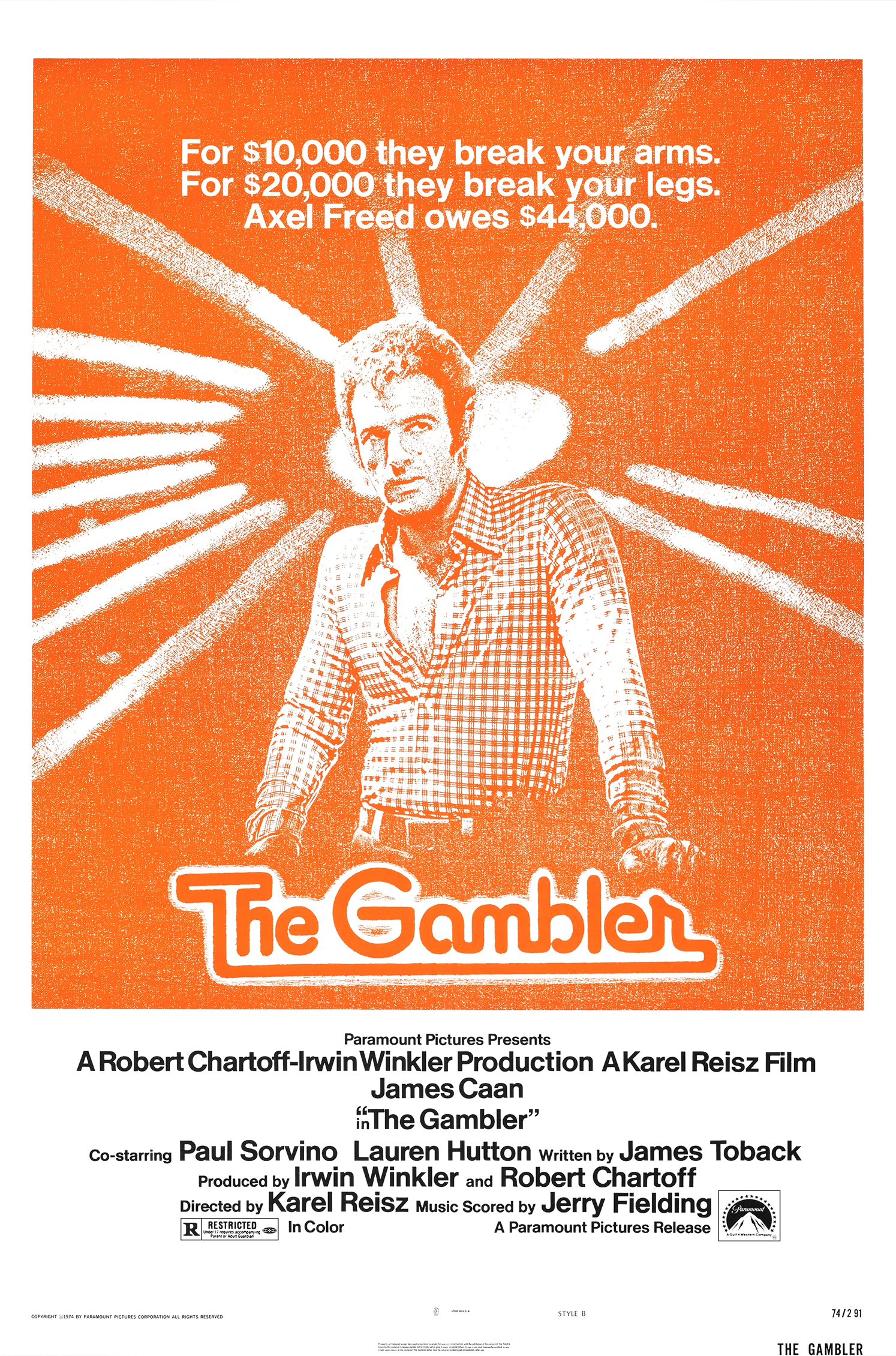
Director: Karel Reisz | Stars: James Caan, Paul Sorvino, Lauren Hutton | IMDb: 6.9/10 | Rotten Tomatoes: 76%
The Gambler is the most literary film on this list — a sustained psychological examination of self-destruction that draws heavily from Dostoevsky's novella of the same name. James Caan plays Axel Freed, a New York literature professor who gambles compulsively, borrows money from his family, runs up catastrophic debts to loan sharks, and seems to be engineering his own annihilation with something approaching relish.
What makes The Gambler powerful and uncomfortable — it is not an easy watch — is its refusal to explain or excuse its protagonist. Axel is not gambling to escape pain or to feel powerful. He gambles because losing, and the danger that comes with it, is the only state in which he feels truly alive. The film engages seriously with the psychology of the compulsive gambler as a distinct personality type: intelligent, nihilistic, and in pursuit not of money but of the voltage of the bet itself.
Caan is extraordinary — giving a performance of coiled, edgy energy that anticipates his career-best work in The Godfather while going further into psychological darkness than that role required. The Gambler was a controversial film on release, criticized by some for seeming to glamorize its protagonist's behavior. Viewed today, it is clearly one of the most honest and unsparing portraits of addiction in American cinema — a film whose influence on subsequent entries in the genre (particularly Owning Mahowny and Uncut Gems) is profound and underacknowledged.
#17 — Lock, Stock and Two Smoking Barrels (1998)

Director: Guy Ritchie | Stars: Jason Flemyng, Dexter Fletcher, Nick Moran, Jason Statham | IMDb: 8.2/10 | Rotten Tomatoes: 77% | Box Office: $28 million worldwide
Guy Ritchie's debut feature is not a gambling movie in the purest sense — it is a crime caper in which gambling is the inciting catastrophe — but its opening card game is one of the most exhilarating set-pieces in the genre, and the entire film is structured around the logic of the gamble: the accumulation of risk, the miscalculation of odds, and the explosive consequences of overconfidence.
Four working-class London friends pool their savings to back card player Eddy (Nick Moran) in a high-stakes game run by a gangster known as Hatchet Harry (P.H. Moriarty). Eddy is cheated out of half a million pounds — an amount he now owes Harry under threat of death — and the scramble to recover that money generates a series of hilariously compounding complications involving drug dealers, armed robbers, and an antique shotgun.
Ritchie's debut film announced a directorial voice of extraordinary energy and invention: quick-cut editing, overlapping narrative timelines, and a cast of working-class archetypes delivered with genuine wit and affection. The card game that opens the film's second act is as technically suspenseful as anything Scorsese has filmed, using camera angle, music, and editing to build a tension that makes the cheating revelation land like a physical blow. Lock, Stock is the most fun gambling movie ever made, and its influence on British crime cinema and popular culture is incalculable.
Honorable Mentions

The genre is extraordinarily rich and several exceptional films narrowly missed this list. The Hustler (1961), Paul Newman's original pool-shark classic and the film that made The Color of Money possible, is a stone-cold masterwork that some critics would place above its sequel. Robert Altman's Secret Honor and Mike Nichols' The Fortune are adjacent works that deal with the gambler's mentality in non-casino contexts.
Shade (2003), a largely forgotten poker thriller starring Sylvester Stallone and Gabriel Byrne, contains some of the most technically accurate card-cheat sequences ever filmed. Two for the Money (2005), despite its commercial intentions, offers a genuinely fascinating behind-the-scenes portrait of the sports-handicapping industry. Roberto Benigni's Johnny Stecchino provides a European counterpoint to the American gambling tradition.
More recently, Molly's Game (2017) deserved higher placement by pure quality of craft but sits at seven based on the relative rankings of the films above it. The 2014 remake of The Gambler, starring Mark Wahlberg, is an underrated update of the original that deserves reappraisal. And for those interested in the gambling genre adjacent to poker specifically, the World Poker Tour documentary series and ESPN's WSOP coverage have produced non-fiction gambling content that rivals the best of the fiction films listed above.
The Psychology Behind Gambling Cinema
What does it tell us about human nature that gambling movies have been a staple of cinema since the medium's earliest days? The answer lies in what the gambling scenario distills about the human condition. The moment before the card is turned or the wheel stops represents, in miniature, the condition of every person alive: we are all waiting on outcomes we cannot fully control, investing resources we cannot fully afford to lose, hoping that the universe will, this once, break our way.
The greatest gambling films work on this existential level. Casino's Ace Rothstein is not destroyed by the mob or by Vegas itself — he is destroyed by his inability to accept that control is always provisional, that the house edge is built into the architecture of the world. Rounders' Mike McDermott has to choose between the security of a normal life and the terrifying freedom of genuine vocation. Uncut Gems' Howard Ratner is a man who has confused the process of gambling with the meaning of his life.
Psychologists who study gambling addiction identify a cluster of cognitive distortions that characterize problem gamblers: the illusion of control, the gambler's fallacy, near-miss bias, and the tendency to attribute wins to skill and losses to bad luck. The greatest gambling films dramatize these distortions with precision and empathy, helping audiences understand both the seduction and the destruction of the bet without needing to experience it themselves.
There is also something specifically cinematic about gambling that makes it such fertile ground for film. Both activities — gambling and watching movies — involve suspension of disbelief, voluntary submission to uncertainty, and the promise of emotional payoff. Both reward patience and punish distraction. The cinema screen and the card table are, in structural terms, the same kind of space: one in which ordinary rules are suspended and heightened states of feeling become available. When a gambling film is working at its best, the audience is not observing the bet — they are placing it.
The films on this list represent the full range of what gambling cinema can achieve: the operatic sweep of Casino, the intellectual pleasure of Rounders, the psychological horror of Uncut Gems, the melancholic honesty of California Split, and the pure cinematic joy of The Sting. Together, they constitute one of cinema's most revealing and enduring genres — a body of work that illuminates the human impulse to risk everything on the turn of a card, again and again and again.
❓ Frequently Asked Questions
What is the highest-rated gambling movie of all time on IMDb?
The Sting (1973) and Lock, Stock and Two Smoking Barrels (1998) both hold an 8.2 rating on IMDb, making them the highest-rated gambling films on the platform. Casino (1995) follows closely at 8.2 as well, while Rain Man (1988) holds an 8.0 rating.
What gambling movie is most recommended for poker players?
Rounders (1998) is the universal recommendation for poker players. It is technically accurate about poker psychology and strategy, features some of the best depictions of no-limit hold'em decision-making ever filmed, and is widely credited with inspiring countless professional players — including multiple World Series of Poker Main Event champions — to take up the game seriously.
Are gambling movies accurate about how casinos actually work?
It varies significantly. Casino (1995) is considered the most accurate portrayal of casino operations ever filmed, particularly regarding mob-era Las Vegas. Owning Mahowny (2003) accurately depicts casino protocols around high-value patrons. 21 (2008) accurately depicts the hi-lo card counting system. Films like Maverick and The Sting are deliberately fantastical and should not be taken as instructional guides.
Which gambling movie best portrays gambling addiction?
Owning Mahowny (2003) and Uncut Gems (2019) are the most clinically accurate portrayals of compulsive gambling disorder. California Split (1974) and Mississippi Grind (2015) also offer deeply honest, non-romanticized depictions of the gambling lifestyle and its psychological costs. All four are essential viewing for anyone seeking to understand problem gambling.
What was the most commercially successful gambling movie ever?
Rain Man (1988) is the highest-grossing gambling film ever made, earning over $354 million worldwide — extraordinary for its era. Though primarily a road movie and family drama, its Las Vegas blackjack sequence cemented it as part of the gambling movie canon. Maverick (1994) follows with $183 million, and 21 (2008) with $157.9 million.
Did Rounders really cause the poker boom?
Yes — this connection is well-documented. The early 2000s Texas Hold'em boom was fueled by several factors: the World Series of Poker's television deal, the invention of hole-card cameras, Chris Moneymaker's famous 2003 WSOP win, and the wide home-video availability of Rounders. Countless professional players cite the film as their initial inspiration, and its dialogue and concepts became foundational vocabulary in the poker community.
Is The Cincinnati Kid (1965) worth watching today?
Absolutely. The Cincinnati Kid remains one of the finest character studies in gambling cinema, and Steve McQueen's performance as The Kid is as compelling today as it was in 1965. Its portrait of Depression-era New Orleans, the mythology of the mentor-vs-challenger duel, and its genuinely shocking conclusion make it essential viewing — not just for gambling movie fans but for anyone interested in classic American cinema.
What poker knowledge do I need to enjoy Rounders?
None, though some basic familiarity with Texas Hold'em enhances the experience. The film does an excellent job of explaining its poker concepts through dialogue and situation, and the dramatic tension is constructed to work for non-poker audiences. Knowing that the river is the final community card in Hold'em and understanding the concept of a 'tell' is sufficient preparation.
Final Thoughts
The gambling movie is one of cinema's most durable and psychologically rich genres because it deals with the most fundamental of human drives: the willingness to risk what you have for what you want. From Martin Scorsese's operatic Casino to the Safdie Brothers' sensory-overload Uncut Gems, from the Depression-era romanticism of The Cincinnati Kid to the working-class realism of Mississippi Grind, these films collectively constitute an extraordinary body of cinematic work.
What unites the greatest entries on this list — and what separates them from the merely entertaining ones — is moral seriousness. The best gambling films take the bet seriously as a human act: they understand what it costs, what it promises, and what it says about the people who cannot stop placing it. They are films about the dangerous beauty of risk, and they are as essential, revealing, and rewatchable as the genre has ever produced.
Whether you approach these films as a passionate bettor, a casual moviegoer, or a student of American cinema, this list offers seventeen entries from the very best the genre has to offer. Start at the top, work your way down, and you will emerge at the other end with a much richer understanding of why, when the cards are in the air, everything feels possible.
FREE STATS & STAKING TRACKER
Log your bets, track CLV, and manage your bankroll like a pro with our institutional-grade tracking tool.
OPEN FREE TRACKER