Blackjack for Noobs: The Only Guide You'll Ever Need

💡 Key Takeaways
- Blackjack has the lowest house edge of any casino table game — as low as 0.28% with perfect basic strategy.
- Basic strategy is a mathematically proven set of decisions for every hand. Memorize it and you play optimally every single time.
- Never take insurance, never play at '6:5' tables, and always stand on hard 17 or higher — these three rules alone save most beginners serious money.
- Bankroll management for blackjack means never putting more than 5% of your session budget on a single hand, and setting a hard stop-loss before you sit down.
- Card counting is completely legal, learnable by anyone, and gives a skilled player a small but real edge over the house.
📑 Table of Contents
- What is blackjack, actually?
- Card values: the foundation of everything
- How a round works, step by step
- Your options at the table
- Basic strategy: the blueprint for every decision
- Splitting pairs: the rules that make it profitable
- Doubling down: when to go aggressive
- The house edge: why table selection matters enormously
- Six myths that cost beginners real money
- Card counting 101: demystifying the most famous skill in gambling
- Bankroll management for blackjack sessions
- Your next steps as a beginner
Most casino beginners lose at blackjack not because they're unlucky — but because they've never learned that this is the one table game where skill genuinely changes the math.
With the right strategy, the house edge drops to under 0.5%. Without it, you're handing the casino 4% or more on every single hand. Here's everything you need to know to go from absolute beginner to confident, strategy-sound player.
What is blackjack, actually?
Blackjack — also called 21 — is a card game played between you and the dealer. You are not competing against other players at the table; their hands are entirely irrelevant to yours. The sole objective is to finish the round with a hand value closer to 21 than the dealer's, without exceeding 21 (which is called 'busting'). That's the entire game in two sentences.
What makes blackjack uniquely powerful among casino games is the decision layer. Unlike roulette or slot machines — where outcomes are purely random — blackjack requires you to choose how to play every hand. Those choices have mathematically correct answers. Learn them, and you shrink the house's advantage to a sliver.
Card values: the foundation of everything

Before you sit down, you need to know the value of every card by reflex. Cards 2 through 9 are worth their face value. Cards 10, Jack, Queen, and King are all worth exactly 10 — no exceptions. The Ace is worth either 1 or 11, whichever benefits your hand most at any given moment.
The Ace is the most powerful card in the deck because of its flexibility. An Ace plus a 6 gives you a 'soft 17' — soft because the Ace can still be counted as 1 (making 7) if drawing another card would otherwise cause you to bust. A 'hard' hand has no Ace, or has an Ace that can only be counted as 1 without busting. This distinction matters enormously when you learn basic strategy.
How a round works, step by step
Once bets are placed, the dealer gives each player two cards face-up, and deals themselves one card face-up and one card face-down (called the 'hole card'). You then act on your hand before the dealer reveals their hole card. This order of play is what gives the skilled player a structural opportunity — the dealer must follow rigid fixed rules, while you can choose intelligently based on everything visible.
After all players act, the dealer flips their hole card and plays out their hand according to fixed house rules: they must keep hitting (drawing cards) until they reach 17 or higher, at which point they must stop. If the dealer busts, all remaining players win automatically — this is the hidden advantage that good players exploit consistently.
Your options at the table
Hit means taking another card — signal this by tapping the table lightly. Stand means taking no more cards — signal with a flat wave over your bet. Double Down means doubling your original bet in exchange for receiving exactly one more card; this is one of the most powerful moves in the game when deployed correctly. Split applies when you hold a pair: you divide them into two separate hands, each backed by an equal bet. Surrender (not available everywhere) lets you fold your hand and recover exactly half your bet. Insurance is a side bet offered when the dealer shows an Ace — it is almost always a mathematical trap and should be declined.
Understanding when each option is correct is the heart of blackjack strategy. The good news: basic strategy tells you definitively which option to choose in every single situation.
Basic strategy: the blueprint for every decision
Basic strategy is the mathematically optimal play for every possible combination of your hand total versus the dealer's visible up card. It was first computed in the 1950s by Roger Baldwin and colleagues using adding machines, and has been verified hundreds of millions of times by computer simulation since. There is no debate about it in the mathematics community: basic strategy produces the single best decision for every scenario.
The strategy resolves to a lookup table: your hand on one axis, the dealer's up card on the other. Some general principles that cover the vast majority of situations: always stand on hard 17 or higher; always hit on 8 or less; double on 10 or 11 whenever the dealer shows a weaker card (2 through 9 for 10, 2 through 10 for 11); stand on 13 through 16 when the dealer shows a bust card (2 through 6), but hit those same totals when the dealer shows 7 or higher. Casinos actually permit printed basic strategy cards at the table — print one and use it openly until you've memorized it.
Splitting pairs: the rules that make it profitable
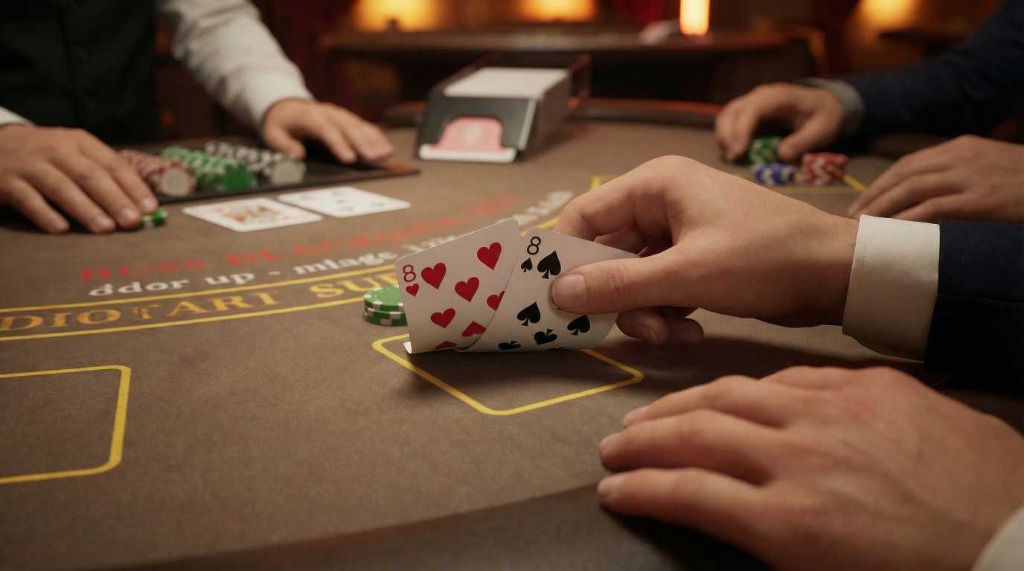
Splitting is one of the most misunderstood actions at the table. Players often split because they have a hunch or want more action — both wrong reasons. Splitting is a strategic decision based entirely on mathematics.
Always split Aces: two hands each starting with an 11 is dramatically better than one hand totaling 12. Always split 8s: a hard 16 is statistically the worst hand in blackjack, while two separate 8s give you two reasonable starting points against almost any dealer card. Never split 10s: a 20 is a near-certain winner, and splitting it into two hands starting at 10 is needlessly risky. Never split 5s: a total of 10 is an excellent doubling opportunity, while two individual 5s are weak starting hands. Never split 4s: a total of 8 is fine to develop with a hit, whereas two separate 4s are poor starting positions.
Doubling down: when to go aggressive
Doubling down is the offensive play that separates blackjack from a passive game. You double your bet in exchange for exactly one more card — no more, no less. The ideal situations are when your hand total gives you a high probability of ending between 18 and 21 with a single card, and when the dealer is in a structurally weak position. Holding a 10 or 11, you have a strong chance of drawing a 10-value card for a total of 20 or 21. When the dealer shows a 4, 5, or 6, they are statistically likely to bust — making it a prime moment to get more money on the table.
A common beginner mistake is to never double out of fear of losing twice the money. Over thousands of hands, skipping correct double-down opportunities is one of the costliest strategic errors possible. The expected value math favors doubling in those situations — trust the math, not your nerves.
The house edge: why table selection matters enormously
The house edge is the casino's mathematical advantage expressed as a percentage of every bet placed. With perfect basic strategy at a favorable table, the house edge is approximately 0.28%. The average blackjack player — making guesswork decisions — faces a house edge of 1.5% to 2%. At a 6:5 payout table, even a perfect basic strategy player faces roughly 2% or higher. Compare this to American roulette at 5.26% or typical slot machines ranging from 2% to 15%, and you understand why blackjack is the most player-favorable game in any casino.
The difference between 0.28% and 2% sounds negligible, but over 500 hands at $20 average bet (representing $10,000 in total action), it is the difference between an expected loss of $28 versus $200. Rule variations compound: a single-deck game with liberal doubling rules and dealer standing on soft 17 is dramatically more favorable than an eight-deck shoe where the dealer hits soft 17 and you cannot double after splits.
The rules to seek out at any table are: blackjack pays 3:2 (never 6:5), dealer stands on soft 17 (labeled 'S17'), doubling after splits is allowed (DAS), and late surrender is available. Walk away from any table offering 6:5 on blackjack — that single rule change adds approximately 1.4% to the house edge and completely negates the benefits of learning basic strategy.
Six myths that cost beginners real money
Myth 1 — 'Always take insurance when the dealer shows an Ace.' Insurance is a side bet with a house edge near 7.7%. Unless you are an expert card counter who knows the remaining deck is heavily loaded with 10-value cards, the correct play is to always decline insurance without exception.
Myth 2 — 'The dealer always has a 10 in the hole.' This assumption leads players toward overly conservative decisions. The dealer has a 10-value card in the hole only about 31% of the time. Basic strategy already accounts for this probability distribution correctly — you do not need to assume the worst.
Myth 3 — 'Bad players at the table hurt your odds.' Over any statistically significant sample, the random decisions of other players neither systematically help nor harm you. Each player's hand is mathematically independent. The cards removed from the shoe can go either way, and on average they do — other players are noise, not a threat.
Myth 4 — 'I'm due for a win after a losing streak.' This is the gambler's fallacy in its purest form. Each hand of blackjack is an independent probabilistic event. Five consecutive losses say absolutely nothing about the probability of the sixth hand. The deck has no memory.
Myth 5 — 'Card counting is illegal.' It is not illegal anywhere in the world. Card counting is a cognitive skill applied to publicly available information visible to everyone at the table. Casinos — as private businesses — may ask skilled counters to stop playing or leave, but card counting is not a criminal act and has never resulted in a legitimate criminal conviction.
Myth 6 — 'The objective is to get as close to 21 as possible.' The real objective is simply to beat the dealer's hand. Sometimes the correct play is to stand on a hard 14 when the dealer shows a 5 — not to risk busting while chasing a higher total. Keeping the true objective clear prevents a huge class of basic strategy errors.
Card counting 101: demystifying the most famous skill in gambling
Card counting is not about memorizing every individual card that has been played. The Hi-Lo system — the simplest and most widely used method in the world — assigns a running numerical tally to the remaining deck composition. Cards 2 through 6 are tagged +1 when they leave the deck (their disappearance helps the player). Cards 10 through Ace are tagged -1 (their presence in the remaining deck helps the player). Cards 7, 8, and 9 are neutral at 0. You simply maintain this running total in your head throughout the shoe.
A high positive running count means the remaining deck is disproportionately rich in 10-value cards and Aces — which favors the player because blackjacks pay 3:2, doubling down becomes more profitable, and the dealer is more likely to bust on stiff hands. To normalize across different shoe depths, divide the running count by the estimated number of decks remaining to get the 'true count.' When the true count rises above +2, skilled counters increase their bet size. This is the mechanism that mathematically shifts the edge from the house to the player — typically by 0.5% to 1.5%.
Learning to count well enough to deploy it profitably in a live casino environment requires hundreds of hours of deliberate practice. For most casual players, mastering perfect basic strategy is the higher-return time investment — it captures most of the mathematical benefit with zero in-session mental overhead.
Bankroll management for blackjack sessions
Even with a razor-thin house edge, short-term variance at blackjack is real and can be brutal. A solid session bankroll is 40 to 50 times your minimum bet. If your minimum bet is $10, arrive at the table with $400 to $500. This provides enough runway to survive a cold run and still be in action when your statistical position improves.
Never increase your bet size after losses in an attempt to 'chase' back what you've lost — this is the Martingale trap, and over time it leads to catastrophic bankroll destruction with mathematical certainty. Flat betting (wagering the same amount on every hand regardless of outcomes) is the discipline that protects your capital and lets basic strategy work over the sample size it needs to express its value. If you choose to spread bets — betting more in favorable situations — always base that decision on the card count, never on emotional momentum.
Set a hard stop-loss before you sit down. Decide the maximum you are willing to lose in this session, and commit to walking away the moment you hit it. Equally, if you are up significantly, consider setting a stop-win: a point at which you lock in your gains and leave the table. The most common way for winning sessions to end in losses is simply staying too long.
Your next steps as a beginner
The single best investment you can make before your first live session is drilling basic strategy until the decisions become automatic. Free online blackjack trainers let you practice thousands of hands at your own pace and will flag every incorrect decision immediately — use them until you make zero mistakes in a hundred consecutive hands.
Print a basic strategy chart and bring it to the casino. Casinos permit this at the table, and any dealer who discourages you from using one is at a table worth leaving. Start at a $5 or $10 minimum table, play flat bets, and focus entirely on executing correct basic strategy decisions for every hand. The difference between a player who uses basic strategy and one who guesses is roughly $170 in expected losses per $10,000 of action. Get the foundation right first. Everything else — counting, advanced plays, rule exploitation — builds naturally on top of it.
📖 Glossary of Terms
Bust
When a hand exceeds 21, resulting in an automatic loss.
Push
A tie with the dealer — your original bet is returned.
Soft hand
A hand containing an Ace counted as 11.
Hard hand
A hand with no Ace, or with an Ace that can only count as 1.
Shoe
The device holding multiple decks of cards, typically 4 to 8 decks.
Penetration
How deeply into the shoe the dealer deals before reshuffling. Deeper penetration favors card counters.
Natural
An Ace plus any 10-value card dealt in the opening two cards. Pays 3:2 at proper tables.
True count
Running count divided by remaining decks. Used in card counting to normalize across shoe depths.
Flat betting
Wagering the same amount on every hand regardless of outcome.
Back-counting
Standing behind a table, watching the count, and only joining when conditions are favorable. Also called 'Wonging.'
S17
Rule notation for 'dealer stands on soft 17' — a player-favorable rule.
DAS
Rule notation for 'double after split is allowed' — another player-favorable rule.
FREE STATS & STAKING TRACKER
Log your bets, track CLV, and manage your bankroll like a pro with our institutional-grade tracking tool.
OPEN FREE TRACKER