How to Calculate Parlay Payout in Sports Betting: The Complete 2026 Guide

💡 Key Takeaways
- A parlay payout is calculated by converting all legs to decimal odds, multiplying them together, then multiplying the result by your stake.
- For positive American odds (+150): Decimal = (Odds ÷ 100) + 1. For negative American odds (-110): Decimal = (100 ÷ |Odds|) + 1.
- A standard 2-leg parlay at -110/-110 pays +264 (3.64x). A 3-legger pays approximately +597 (6.97x). Each additional leg multiplies the risk and the reward.
- The sportsbook's built-in vig compounds with every leg you add — on a single -110 bet the house edge is ~4.5%, but on a 5-leg parlay it balloons past 20%.
- If one leg of your parlay pushes (ties), that leg is removed and the parlay recalculates at the next-lowest number of teams.
- Professional bettors rarely extend beyond 3-leg parlays, where payout is still meaningful but the compounding vig remains manageable.
📑 Table of Contents
- What Is a Parlay Bet?
- The 3-Step Parlay Payout Formula
- Step 1 – Converting American Odds to Decimal
- Step 2 – Multiplying All Legs Together
- Step 3 – Calculating Total Payout and Profit
- Real-World Parlay Payout Examples
- Standard Parlay Payout Chart (2 to 10 Legs)
- The House Edge and Why It Compounds
- Pushes, Cancellations, and Ties in Parlays
- Parlay Types You Should Know
- Smart Parlay Strategy: What the Pros Do
A parlay bet is the most electrifying wager in sports betting — and also the most misunderstood. Every bettor has dreamed of turning a $20 ticket into $2,000 overnight. But here's the uncomfortable truth: most people who place parlays have absolutely no idea what the bet is actually worth, what it should pay, or how badly the sportsbook has tilted the math in its own favor.
Understanding how to calculate a parlay payout is not just an academic exercise — it is the single most important skill separating a casual recreational bettor from someone who treats their bankroll with real discipline. When you know the formula, you can verify sportsbook payouts, spot underpriced lines, identify when a parlay actually offers value, and stop blindly chasing jackpot tickets that are statistically designed to drain your wallet.
In this complete guide, we walk you through every step of the parlay payout calculation from scratch — covering American odds, decimal odds, fractional odds, multi-leg formulas, real worked examples, a full payout reference chart, how pushes affect your ticket, and the strategic truths that professional bettors use every single day. By the end, you will never need to guess at a parlay payout again.
What Is a Parlay Bet?
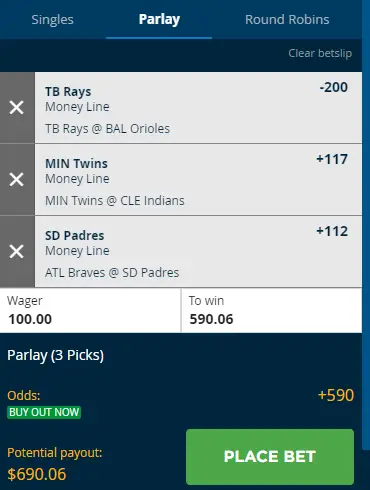
A parlay is a single wager that chains two or more individual bets — called 'legs' — together into one combined ticket. The defining rule of every parlay is absolute and unforgiving: every single leg must win for the bet to pay out. If even one of your ten legs loses, the entire parlay is graded as a loss, regardless of how well the other nine performed.
The appeal is obvious. Because each winning leg feeds its payout into the next bet like a compounding investment, the potential return grows exponentially. A $10 bet on three -110 favorites can return over $59 — compared to about $19 from three separate straight bets at the same odds. That kind of amplification is why parlays now account for more than 60% of online sports bets placed in some U.S. states.
Parlays are available on virtually every sport — NFL, NBA, MLB, NHL, soccer, tennis, MMA, and more — and most major sportsbooks allow anywhere from 2 to 15 or even 25 legs per ticket. You can combine moneylines, point spreads, over/unders, and player props all on the same slip. The only limitation most books enforce is that you cannot combine two outcomes from the same game if they are statistically correlated — a rule specifically designed to prevent bettors from gaining an unfair mathematical edge.
The 3-Step Parlay Payout Formula
Calculating a parlay payout manually comes down to three clean steps that you can apply to any combination of legs, any odds format, and any stake size. The entire process is built on one foundational truth: you must work in decimal odds. Decimal odds are the universal language of parlay math because they represent your total return per dollar wagered — including your stake — which makes multiplication clean and intuitive.
The master formula is this: Total Payout = Wager × (Decimal Odds Leg 1 × Decimal Odds Leg 2 × ... × Decimal Odds Leg N). To find your profit, subtract your original stake from the total payout. Everything else — odds format conversion, cross-checking American odds, verifying sportsbook displays — is just prep work feeding into this core equation.
Think of it like a chain of investments where each winning bet is immediately rolled into the next one. If Leg 1 turns $10 into $19.09, that $19.09 is then wagered on Leg 2. If Leg 2 hits, that amount is rolled into Leg 3, and so on. The multiplication of decimal odds perfectly replicates this compounding reinvestment effect in a single instant calculation.
Step 1 – Converting American Odds to Decimal
Since virtually every U.S. sportsbook displays odds in American format — positive numbers for underdogs, negative numbers for favorites — you need to convert each leg before you can multiply anything. The conversion is different depending on whether the number is positive or negative, and it is essential to get this right because even small rounding errors compound across multiple legs.
For positive American odds (underdogs), the formula is: Decimal Odds = (American Odds ÷ 100) + 1. So if a team is listed at +150, you calculate (150 ÷ 100) + 1 = 2.50. This means a $1 wager returns $2.50 in total — your $1 stake back plus $1.50 in profit. Positive odds always convert to decimal values above 2.00, which serves as a useful sanity check.
For negative American odds (favorites), the formula is: Decimal Odds = (100 ÷ |American Odds|) + 1. So if a team is at -110, you calculate (100 ÷ 110) + 1 = 0.909 + 1 = 1.909. At -200, it becomes (100 ÷ 200) + 1 = 1.50. Negative odds always convert to decimal values between 1.00 and 2.00. A result below 1.00 is impossible and would indicate an arithmetic error. Here are the most commonly encountered conversions at a glance: -110 = 1.909, -120 = 1.833, -130 = 1.769, -150 = 1.667, -200 = 1.500, +100 = 2.000, +110 = 2.100, +130 = 2.300, +150 = 2.500, +200 = 3.000.
Step 2 – Multiplying All Legs Together
Once every leg is expressed as a decimal, the next step could not be simpler: multiply them all together in a single chain. The result is your combined parlay multiplier — the number by which your stake will be multiplied to produce your total payout. The formula is: Combined Multiplier = Decimal Leg 1 × Decimal Leg 2 × Decimal Leg 3 × ...
For example, imagine a 3-leg parlay consisting of -110, +130, and -150. Converting each gives you 1.909, 2.300, and 1.667. Multiplying them in sequence: 1.909 × 2.300 = 4.391, then 4.391 × 1.667 = 7.320. Your combined multiplier is 7.32. Notice how adding just one underdog at +130 — instead of three standard -110 lines — dramatically inflates that number.
The key insight is that this multiplication is not additive — it is exponential. Each new leg does not simply add to your potential payout; it multiplies everything that came before it. This is exactly why a 10-leg parlay can return over $64,000 on a $10 bet at -110 per leg. It is also exactly why the probability of hitting all ten collapses to a fraction of one percent. The math rewards and punishes in equal measure.
Step 3 – Calculating Total Payout and Profit
With your combined multiplier in hand, the final calculation is straightforward multiplication followed by one subtraction. Total Payout = Wager Amount × Combined Multiplier. Then, Profit = Total Payout − Wager Amount. This is the number that represents your actual winnings — the money you receive above and beyond getting your stake returned.
Using the example from Step 2, if your combined multiplier is 7.32 and you wager $50: Total Payout = $50 × 7.32 = $366.00. Profit = $366.00 − $50.00 = $316.00. To express this as American odds for reference, since 7.32 is greater than 2.00, the conversion is (7.32 − 1) × 100 = +632. Your $50 bet pays +632 American odds.
Always keep the distinction between 'total payout' and 'profit' crystal clear in your mind. Sportsbooks sometimes display only the profit figure (your winnings) while other times they show total return including stake. A $10 ticket showing a '$69.58 payout' on a 3-legger at -110 per leg means you receive $69.58 back in total — not that you pocket $69.58 on top of your $10. Your actual profit is $59.58. This distinction matters enormously when evaluating whether a parlay represents good value against its individual components.
Real-World Parlay Payout Examples
Example 1 — The Classic 2-Leg Even Money Parlay: You parlay two teams, each at +100 (even money). Converting: +100 = 2.00 decimal for both legs. Multiplying: 2.00 × 2.00 = 4.00. On a $100 wager, your total payout is $400 and your profit is $300 (+300 American odds). Each individual win would have paid $100 in profit, so the parlay pays three times the combined straight-bet profit — demonstrating the premium the parlay format delivers.
Example 2 — The Standard Spread Parlay (3 Legs at -110): This is the most common parlay scenario, covering three point spreads or totals at the standard -110 vig. Converting -110 to decimal gives 1.909. Multiplying three identical values: 1.909 × 1.909 × 1.909 = 6.966. On a $50 bet: Total Payout = $50 × 6.966 = $348.30. Profit = $298.30. In American odds, this is approximately +597 — nearly 6-to-1 on your money. Compare that to placing three separate $50 bets at -110 and winning all three, which yields about $136 in profit. The parlay pays more than double for the same three picks.
Example 3 — The Mixed Odds Parlay (Favorites Plus One Underdog): You build a 3-leg parlay with legs at -300, -200, and +120. Converting: -300 = 1.333, -200 = 1.500, +120 = 2.200. Multiplying: 1.333 × 1.500 = 2.000, then 2.000 × 2.200 = 4.400. On a $100 wager: Total Payout = $440, Profit = $340 (+340 American odds). Notice how the two heavy favorites (-300 and -200) dramatically suppress the payout despite being near-certain outcomes individually. This illustrates why stacking heavy favorites in a parlay is often poor value — you accept substantial combined risk for a payout that barely exceeds the risk-adjusted reward of a single straight bet.
Example 4 — The 4-Leg Mixed Parlay: Legs at -110, +150, -130, and +200. Converting: 1.909, 2.500, 1.769, 3.000. Multiplying all four: 1.909 × 2.500 = 4.773, × 1.769 = 8.444, × 3.000 = 25.33. On a $20 bet: Total Payout = $506.60, Profit = $486.60 (+2433 American odds). This demonstrates how including even one or two underdogs transforms a parlay's payout profile dramatically.
Standard Parlay Payout Chart (2 to 10 Legs at -110)
The payout_table above shows exact payout multipliers, American odds equivalents, implied win probability, and $100 wager payouts for 2-leg through 10-leg parlays where every leg is priced at the standard -110. This is the most practical reference you will ever use, as point spreads and totals are priced at -110 the vast majority of the time.
Study these numbers carefully. A 10-leg parlay at -110 each has barely a 0.16% chance of landing. You would statistically need to place roughly 625 such tickets before expecting one winner. The payout is genuinely enormous — but the house collects the losing tickets on 99.84% of attempts. Always treat win probability alongside payout when evaluating any parlay's true value.
The House Edge and Why It Compounds
Understanding the compounding vig is what separates bettors who survive long-term from those who don't. On a single -110 bet — the most common odds in sports betting — the sportsbook's built-in margin (called the 'vig' or 'juice') is approximately 4.55%. This means for every $100 wagered across both sides of the market, the book keeps about $4.55 in profit.
When you add a second -110 leg to your parlay, that 4.55% vig doesn't add — it multiplies. The house edge on a 2-leg parlay at -110 rises to approximately 9%. By a 3-leg parlay, it crosses 13%. At 5 legs, the edge exceeds 20%. By the time you've built a 10-leg parlay, the sportsbook's mathematical advantage is nearly 35% of every dollar wagered. To put that in perspective, a casino roulette wheel — widely considered one of the worst bets in the house — only carries a house edge of 5.26% on American wheels.
This is the mechanism sportsbooks love about parlays: they look generous from the outside, dangling six-figure payouts on $10 tickets, while quietly pocketing an ever-growing percentage of each bet. The published payout for a 3-leg parlay at -110 might be roughly +597, but the mathematically 'fair' payout — what you'd receive with no vig at all — would be closer to +700. That gap is the invisible cost of playing the parlay. It's not visible in any single bet, but it is ruthlessly consistent and grows larger with every leg you add.
Pushes, Cancellations, and Ties in Parlays
A 'push' occurs when a leg of your parlay results in a tie — for example, a team wins by exactly the point spread. In virtually all sportsbooks, a push does not kill your parlay. Instead, that leg is removed from the ticket and the payout is recalculated as if the parlay never included it. A 5-leg parlay with one push becomes a 4-leg parlay. The overall payout decreases because there are now fewer legs multiplying together, but your stake is not lost.
The same treatment applies if a game is canceled, postponed, or rescheduled. That leg is calculated at 1.00 in decimal odds — mathematically equivalent to removing it entirely — and the remaining legs determine the payout. A critical edge case: if you have a 2-leg parlay and one leg pushes, the bet reverts to a standard straight bet on the remaining leg. If that leg wins, you are paid out at the single-game odds.
One important nuance that varies by sportsbook: some books treat a push differently in correlated bet types or same-game parlays, and a small number of platforms handle tie outcomes as outright losses in certain prop markets. Always review the specific house rules at your book before placing a parlay, especially for exotic bet types. The standard treatment — push = leg removed and revert down one tier — applies across most major U.S. platforms.
Parlay Types You Should Know
Standard Parlay: The classic format — two or more legs from different games, all of which must win. This is what most bettors picture when they hear the word 'parlay.' Calculation follows the exact 3-step formula described above with no modifications.
Same-Game Parlay (SGP): A newer and wildly popular format that allows you to combine multiple outcomes from a single game — for example, a team to win, a player to score over 1.5 touchdowns, and the total to go over 48.5. Sportsbooks typically impose correlation restrictions and often use proprietary odds for SGPs rather than straight decimal multiplication, so the payout may differ from a standard manual calculation.
Round Robin Parlay: A sophisticated format where you select a group of teams and create every possible combination of 2-leg (or 3-leg) parlays within that group. For example, selecting four teams in a round robin creates six different 2-leg parlays covering all possible pairings. This provides partial protection: your entire stake isn't lost if one team fails, because only the parlays containing that team lose. Round robins are a professional-grade middle ground between straight bets and high-risk traditional parlays.
Correlated Parlay: A parlay where two or more legs are statistically linked — for instance, betting the game Over AND a specific team to win on the moneyline, since high-scoring games benefit the same team's odds. When the legs are correlated, the true probability of hitting all of them is higher than a standard independent-probability calculation suggests, giving the bettor a mathematical edge. Most sportsbooks block obvious correlations, but opportunities exist particularly in player props, alternative lines, and less-trafficked markets.
Smart Parlay Strategy: What the Pros Do

The single most actionable advice from professional bettors and quantitative analysts is this: limit yourself to 2 or 3-leg parlays if you want any realistic long-term value. At 2 legs, the house edge is roughly 9% — uncomfortable but survivable with an edge on your picks. At 3 legs, it rises to about 13%. Beyond that, the compounding vig eats your edge faster than any handicapping model can generate it.
Line shopping is disproportionately powerful in parlays. Because parlay odds multiply together, even a tiny difference in individual leg prices has an amplified effect on the final payout. Getting -108 instead of -110 on each leg of a 4-leg parlay improves your payout by approximately 3%. That might sound small, but over hundreds of parlays it represents thousands of dollars of reclaimed value. Always compare lines across at least two or three sportsbooks before submitting any parlay ticket.
Avoid adding heavy favorites to juice up a parlay. This is one of the most common and costly mistakes recreational bettors make. Adding -500 or -600 favorites to a ticket feels like getting free money, but those short-price favorites still lose — and when they do, they destroy your entire bet without meaningfully increasing your overall payout. A -500 favorite converts to only 1.20 decimal odds, contributing almost nothing to the multiplier while carrying real loss risk.
Finally, always treat parlay winnings as entertainment return rather than income. The mathematical reality is that the house edge grows with every leg, and even a skilled bettor who has a genuine 55% win rate on individual legs will struggle to overcome a 20%+ house edge on large parlays. Use parlays sparingly, size them small relative to your bankroll, and view the occasional big hit as a bonus — never a financial strategy.
❓ Frequently Asked Questions
What is the simplest way to calculate a parlay payout?
The simplest method is: convert every leg's American odds to decimal format, multiply all the decimal odds together to get your combined multiplier, then multiply that by your stake. Subtract your stake to find your profit. For example, three legs at -110 each gives decimal odds of 1.909 each. Multiplying 1.909 × 1.909 × 1.909 = 6.966. A $100 wager returns $696.60 total, or $596.60 in profit.
How do I convert American odds to decimal for a parlay calculation?
For positive American odds (underdogs), divide the odds by 100 and add 1. So +150 becomes (150 ÷ 100) + 1 = 2.50. For negative American odds (favorites), divide 100 by the absolute value of the odds and add 1. So -110 becomes (100 ÷ 110) + 1 = 1.909. Positive odds always produce a decimal above 2.00, and negative odds always produce a decimal between 1.00 and 2.00.
What happens to my parlay if one leg ties or pushes?
If a leg pushes — meaning the outcome is an exact tie with the spread or total — that leg is removed from your parlay and the payout is recalculated at the next-lowest tier. A 4-leg parlay with one push pays out as a 3-leg parlay. Your stake is not lost. If one game is canceled or postponed, the same rule applies — it is treated as 1.00 decimal odds and effectively removed from the calculation.
How much does a 2-team parlay pay on a $100 bet?
At the standard -110 odds used for most point spreads and totals, a 2-team parlay pays approximately $264 in profit on a $100 bet — a total payout of $364. This is equivalent to approximately +264 in American odds. If the legs carry different prices, the exact payout will vary based on the formula. Higher-priced underdogs in the parlay will increase this number substantially.
How much does a 3-team parlay pay on a $100 bet?
At -110 per leg, a 3-team parlay pays approximately $596 in profit on a $100 bet — a total payout of $696. In American odds, this is roughly +596. The exact probability of hitting all three legs is about 14.4%, meaning you should expect to win roughly one out of every seven such parlays over the long run.
What is the maximum number of legs I can include in a parlay?
Most major U.S. sportsbooks allow between 12 and 20 legs on a standard cross-game parlay, and roughly 10 to 12 legs on a same-game parlay. Some platforms extend to 25 legs for standard formats. However, the mathematically rational ceiling for any serious bettor is 2 to 3 legs, where the compounding house edge is still survivable.
Why do sportsbooks pay less than the 'true' fair odds on parlays?
Sportsbooks embed a profit margin — called the vig or juice — into every individual bet's odds. When you build a parlay, that vig compounds multiplicatively with each additional leg. On a single -110 bet the house edge is approximately 4.5%, but that edge grows to 9% on a 2-legger, 13% on 3 legs, and beyond 25% on 6 or more legs. This is why the payout for a 3-leg parlay at -110 is roughly +596, when the mathematically fair payout (no vig) would be closer to +700.
Can I calculate a parlay payout if my legs are in different odds formats?
Yes. The key is to convert everything to decimal format before multiplying. Convert American odds using the formulas above. Convert fractional odds (like 3/2) to decimal by dividing the fraction and adding 1 (3/2 = 1.5 + 1 = 2.50). Once all legs are in decimal format, the multiplication works identically regardless of what format each leg was originally displayed in.
Is a same-game parlay calculated the same way as a standard parlay?
Not always. Standard parlays use straightforward decimal multiplication across independent events. Same-game parlays (SGPs) often involve correlated outcomes from a single game — a team winning AND the total going over, for instance. Because these outcomes influence each other's probability, sportsbooks typically use proprietary SGP pricing models rather than simple decimal multiplication. The displayed odds on an SGP are the authoritative figure; do not expect the manual formula to match exactly.
What is a round robin parlay and when should I use one?
A round robin is a format where you select a group of teams and automatically generate every possible smaller parlay from that group. Choosing four teams in a round robin creates six 2-leg parlays covering all pairings. The advantage is partial protection: you can still profit even if one or two picks fail. Round robins are best suited to situations where you are confident in several picks but want insurance against a single upset destroying your entire stake — the ideal middle ground between the safety of straight bets and the upside of full-card parlays.
Conclusion: Master the Math, Master the Bet
Calculating a parlay payout is not complicated — but it demands precision. The three-step process is the same regardless of whether your ticket has two legs or twelve: convert every leg to decimal odds, multiply them all together to find your combined multiplier, and then multiply that figure by your stake. Subtract your original wager to find your profit. That is the entire formula.
What makes this knowledge genuinely powerful is not just the ability to check a sportsbook's displayed payout — it is the deeper understanding of what every additional leg costs you. The house edge does not stay flat as you add legs; it snowballs. Every leg you add to a parlay beyond three or four is a leg that hands more mathematical advantage back to the book. The bettors who survive long-term are the ones who use parlays as a calculated, occasional tool rather than a daily lottery ticket strategy.
Keep your legs limited to two or three when possible. Always shop lines before locking in a parlay, because every fractional improvement in individual leg pricing multiplies into real money at the final payout. Understand how pushes are handled at your sportsbook before they happen, not after. And above all, never confuse a spectacular maximum payout with a valuable expected return.
Armed with this formula, this reference chart, and a clear view of how the vig compounds, you now have everything you need to evaluate every parlay you will ever build — and to bet with your eyes fully open.
FREE STATS & STAKING TRACKER
Log your bets, track CLV, and manage your bankroll like a pro with our institutional-grade tracking tool.
OPEN FREE TRACKER